




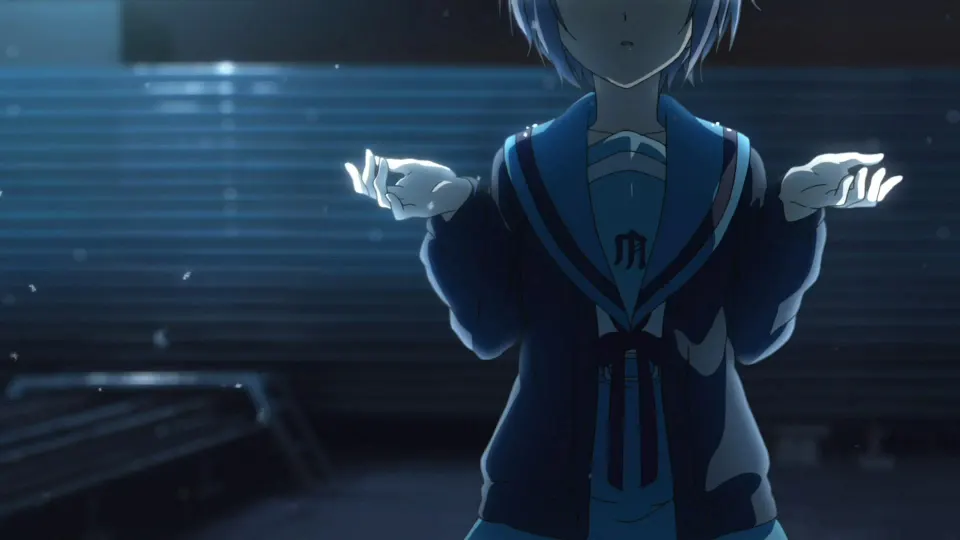

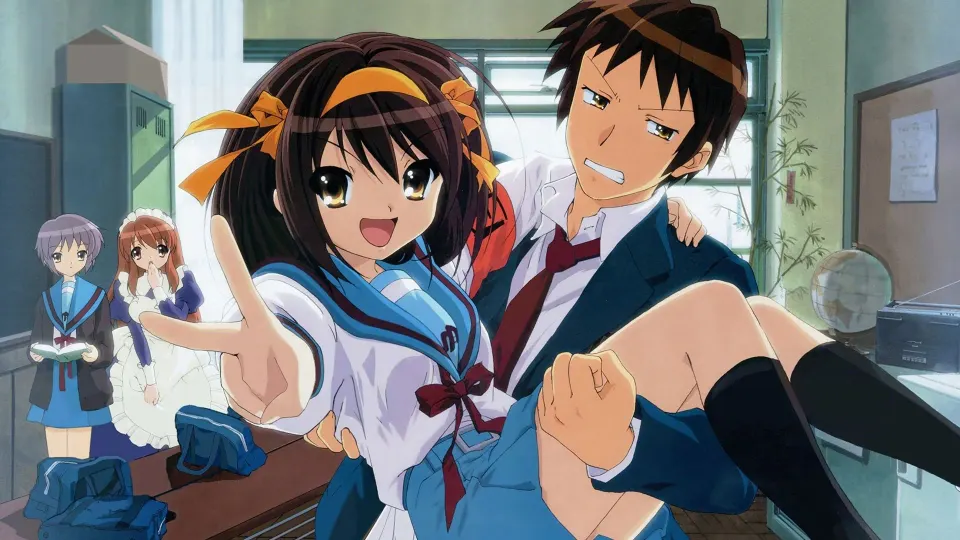









The Melancholy of Haruhi Suzumiya: A Philosophical Comedy Disguised as a School Anime If you tried to describe this series in one sentence, it would go something like: "A girl who doesn't know she's God forces her friends to search for aliens, and accidentally decides the fate of the universe along the way." Sounds absurd? Partly, it is. But that absurdity hides one of the smartest and warmest stories in anime. What It's Actually About On the surface, The Melancholy of Haruhi Suzumiya is a school comedy about the tireless Haruhi, who creates the "SOS Brigade" to search for espers, aliens, and time travelers. Beneath the surface, it's a postmodern deconstruction of the genre, where an ordinary teenager's boredom becomes an ontological threat. Because Haruhi, without knowing it, is a local god: reality bends to her mood. When she's bored, the world starts to crack. The Philosophy Hidden in a School Hallway The entire franchise rests on one very simple, almost childish question: why am I not special? In a key scene, Haruhi recalls how, as a child, she saw a crowd at a train station after a baseball game — "like grains of rice." And she realized: she was just one of fifty thousand, and those fifty thousand were just a drop in the ocean. The world around her literally lost its color. From that moment, she began rebelling against ordinariness: creating clubs, chasing the impossible, demanding miracles from life. From an existentialist angle, this is almost Camus: faced with absurdity, Haruhi doesn't surrender — she chooses to act. It's just that her way of "acting" happens to be a cosmic-scale problem. And behind all that philosophy lies a warm, almost aching feeling: nostalgia for school, where everything was loud, ridiculous, and it felt like it would last forever. How It's Drawn Kyoto Animation goes all out here. The art style is built on contrast: everyday scenes are soft, warm, attentive to detail (steam rising from tea in the clubroom, light on the windows, folds in clothing). But when Haruhi loses control, the style breaks sharply: gray voids, glowing lines, surreal spaces. That visual rupture is the narrative language: you thought you were watching a school comedy? Think again. The character design works the same way. Mikuru is deliberately "cute" to the point of absurdity, Nagato is emotionless to the limit, Itsuki has a perfect smile like a mask. And Haruhi is almost always in "extreme" states: too loud, too angry, too obsessed. Only in rare moments does something fragile flicker across her face — and every time, it lands exactly where it should. Directorial Pranks We can't skip the studio's main act of mischief: the non-linear broadcast order of 2006. Episodes aired out of chronological order, the way Kyon perceives them — that is, in chaos. It's not posturing; it's a technique. The viewer feels like the same disoriented schoolkid trying to assemble a puzzle out of absurdity. If you want, watch it in "correct" order — nobody's stopping you. But you'll lose that very dizziness. Honestly, the Flaws Not everything is perfect. Mikuru remains more of an "object" than a full character in most scenes — her function sometimes outweighs her personality. And the early episodes can feel cruel by modern standards. But if you get past that, the series reveals itself as something rare: funny, smart, and unexpectedly touching all at once. Verdict The Melancholy of Haruhi Suzumiya is an anime about how even the most ordinary life can turn out to be a story with God in the leading role. It makes you laugh, sometimes clutch your head, and sometimes stare at the ceiling at night. And all of it happens in a room called the "SOS Brigade," over eternally bad tea and eternally endless cookies. Welcome to Haruhiism. You've already been accepted.
 Shikimori
 AniList




Sign in to comment. Sign in →
No comments yet. Be the first?